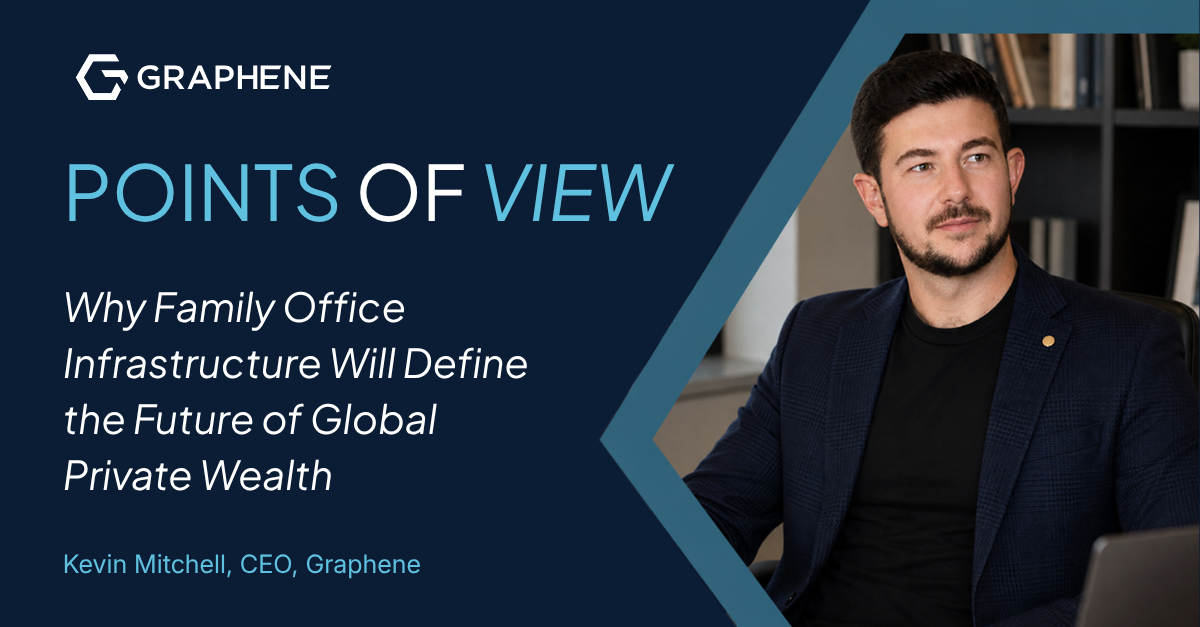
Kevin Mitchell, CEO, Graphene
I have spent years inside the conversations that shape modern family office strategy, and what I keep hearing is the same paradox. Family offices managing significant global wealth have never been more sophisticated in their investment thinking, yet the infrastructure beneath them has rarely been more fragmented, slow or intrusive. In fact, the gap between the ambition of a global family office and the operational reality of the banking networks supporting it has become one of the defining tensions in private wealth today.
The reality is that global family office infrastructure has become a strategic question, not just an operational one. Families managing wealth across multiple jurisdictions, multiple custodians and multiple structures are no longer willing to absorb the cost of friction. They are no longer willing to accept onboarding that takes months when it should take days. And they are no longer willing to live with reporting that arrives weeks after the events it describes. The expectation has changed. The infrastructure has not.
The Hidden Friction Inside Global Family Office Operations
In my experience, the friction inside a global family office rarely shows up in the investment results. It shows up in the operating layer. Onboarding moves at the pace of the slowest custodian. Documentation requests duplicate across every relationship. Each private bank introduces its own process, its own timelines, its own controls and its own data format. What should feel like a single coherent wealth structure begins to feel like a collection of disconnected pipes.
The bottom line is that for a family office running cross border holdings, direct investments, succession structures and managed mandates, every additional relationship in the network adds operational drag. Days disappear into duplicated checks. Visibility breaks across siloed reporting. And the family experience, which should reflect the sophistication of the wealth strategy itself, ends up shaped by whichever provider in the chain is slowest, loudest or least joined up.
This is not a problem of intent. Private banks and global custodians are genuinely capable inside their own world. The problem is that none of them were designed to orchestrate complex multi jurisdictional wealth as a single coherent operating model. They were designed to deliver their own service, well, on their own terms.
Why Traditional Banking Networks Will Never Solve This
For decades, the assumption was that the right combination of private banking relationships could substitute for an operating spine. In fact, that assumption shaped how most family offices were built. Layer the best providers on top of one another. Trust that the relationships would carry the orchestration. Accept the friction as a cost of doing business at this level.
That model will not survive the next era of global wealth.
Three forces are pulling against it. Families are becoming more global, with structures spanning more jurisdictions than ever before. Investment strategies are becoming more diverse, with private markets, direct investments and managed strategies all running simultaneously. And the next generation of wealth holders is arriving with expectations shaped by digital experiences in every other part of their life. They will not accept a multi week onboarding journey. They will not tolerate reporting they have to chase. And they will not delegate visibility to a network of providers that cannot agree on a single version of the truth.
The reality is that solving this requires something the banking network on its own cannot provide. A private, unified infrastructure layer that sits across the network rather than inside any one part of it.
“The result was rapid onboarding and funding within days rather than months. A single consolidated view across global assets and custodians.”
Kevin Mitchell, CEO, Graphene
What Modern Family Office Infrastructure Looks Like in Practice
A recent Graphene client illustrates exactly what this looks like in practice. A highly respected private family office managing significant international wealth and a sophisticated direct investment book came to us with a clear problem. They were not looking for new banking relationships. They were looking for a way to make the relationships they already had work as a single, coherent operating environment. Onboarding had become slow. Custody had become fragmented. Reporting had become inconsistent. The experience no longer matched the ambition of the long term wealth plan.
We deployed our end to end investor experience and custody orchestration capability, with SEI sitting behind it, alongside our proprietary data and reporting layer. The goal was simple. Unify onboarding. Unify custody. Unify data. Deliver clarity immediately.
The outcome was both immediate and measurable. Onboarding and funding completed in days rather than months. A single consolidated view across global assets, custodians and structures. A modern digital experience that gave the family full oversight without operational noise. And a scalable foundation now underpinning the entire global wealth and succession plan.
From my perspective, this is what modern family office infrastructure should always have looked like. Not a replacement for the banking network, but an orchestration layer above it. Not an extra system, but a private intelligent layer that does the hard work others were never structured to do.
The Choice Every Family Office Will Have to Make
Every family office of meaningful scale will, sooner or later, face the same decision. Continue to absorb the cost of friction across a network of providers that were never designed to work as one. Or adopt a private infrastructure layer that turns that network into a single operating environment.
The families I see moving first are not doing this for technology reasons. They are doing it because they want speed, discretion, control and clarity in equal measure. They want institutional strength without institutional rigidity. They want a digital experience that matches the sophistication of their strategy. And they want a scalable foundation that supports the next generation, not just the current one.
In fact, I expect this decision to become one of the defining moves of the next decade in private wealth. The family offices that move first will set a new benchmark for what global wealth operations should feel like. Those that delay will continue to absorb friction that has no place in a properly run operating environment.
Family offices do not want complexity. They want control, clarity and confidence. They want infrastructure and people that adapt to their world, not the other way around. That is the standard global private wealth is moving toward.
That is the standard Graphene is built to deliver.
Download the Case Study
If you are part of a family office managing global wealth and facing similar friction around onboarding custody or cross border structures this case study will resonate.
Click the button below to get instant access to the private family office case study.