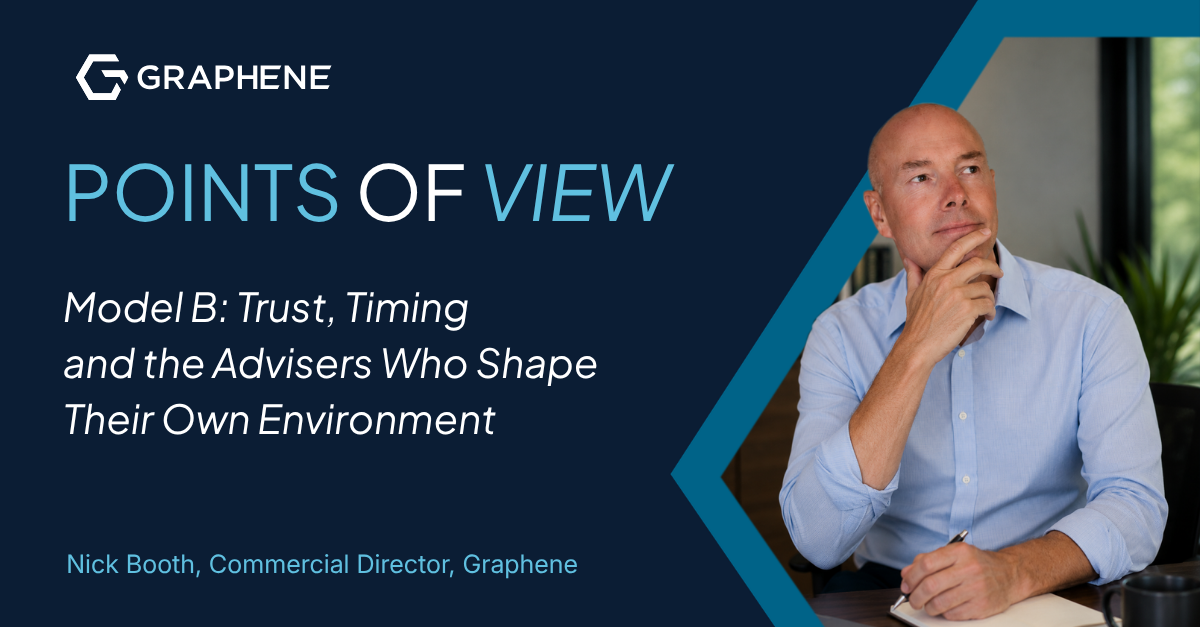
Nick Booth, Commercial Director, Graphene
For too long, the platform has been something that happens to advisers. You build a client relationship over years. You earn the trust, you learn the goals, you develop a way of working that reflects your own values. Then you place that client on a platform, and from that moment the experience they have is dictated by someone else. The look of it. The feel. The way it communicates. The fee structure underneath it. The rules about what’s accessible and what isn’t. None of it shaped by you, all of it inherited from a platform built for the widest possible market rather than for your clients in particular.
That’s not a minor operational inconvenience. It’s a structural mismatch between accountability and control, and under Consumer Duty that mismatch is getting harder to ignore.
In my time as Commercial Director at Graphene Platforms, I’ve spoken with a lot of IFAs, wealth managers, family offices and trusts sitting at exactly this crossroads. Some are content with traditional third-party platforms that handle most things for them, and that’s a perfectly reasonable place to be. Others reach a point where they want greater control. What separates the two usually comes down to two things: trust and timing.
The prescriptive platform problem
Traditional platforms are prescriptive by design. They have a look, a feel, a fixed way of presenting information and defining what advisers and clients can and can’t do inside their walls. That standardisation is a reasonable commercial decision for the platform business, because running one at scale requires it. But the adviser using it has no meaningful say in any of it.
Use a prescriptive platform and you’re borrowing someone else’s environment to house your clients. The client logs in and sees the platform’s brand, the platform’s navigation, the platform’s version of what a good investment experience looks like. Your identity, your values, your approach exist in the gaps between what the platform allows. The commercial model reinforces it: the fees are set by the platform, you charge on top, and you explain it all to clients using language someone else wrote.
The regulation sharpens the tension. Under the FCA’s Consumer Duty, advisers act as distributors, responsible for making sure the products and services they recommend deliver good outcomes. You can’t outsource that. The Duty sits with you regardless of whose platform your clients are on. And yet on a prescriptive platform you have limited ability to shape the environment, the experience, or the commercial terms that bear directly on those outcomes.
What Model B actually changes
Model B, as enabled through Graphene Platforms, starts from a different premise. Rather than placing clients into an environment you had no hand in designing, it lets you shape the platform experience from the ground up. How it presents. How it communicates. What the client journey feels like. What investment universe is accessible. You determine the environment, and the platform exists to serve that rather than impose its own.
The commercial model changes with it. You set your own fees, structured around your service and your clients, and you collect them directly. You become the platform operator: holding the commercial relationship, shaping the experience, owning the value you create. Firms tend to make this move when they’re scaling up, when they want real differentiation, or when they’re feeling the weight of legacy systems and costs. You build something that reflects your firm, and you partner for the complex operational backbone behind it: custody, execution, compliance, admin.
Not every firm wants that, and I’m always honest about it. Many prefer a white-labelled approach, using robust infrastructure under their own brand, delivering a professional experience to clients while staying focused on advice, relationships and growth. No single path fits all.
The responsibility is real and that’s the point
It would be misleading to sell Model B as the benefits of running a platform with none of the duties. The responsibilities are real, and they’re split clearly. Graphene carries the platform-level regulatory weight. As the FCA-authorised platform service provider, it’s responsible for the operational and regulatory infrastructure, including the CASS rules governing how client money and custody assets are segregated, reconciled and protected if a firm fails. Under CASS 6, custody assets are held separately from firm assets and protected in the event of failure. Graphene also arranges connection to a tier-one custody provider, so client assets sit with an institution of the scale and standing that clients and counterparties expect. You don’t arrange custody. You don’t carry custodial risk. Your clients still get institutional-grade protection at the core of the proposition.
You carry the client-facing responsibilities. As a distributor under Consumer Duty, you’re accountable for suitability, for the quality of advice, for the integrity of client communications, for the ongoing fit of what you offer. You can’t delegate that, and Model B doesn’t pretend you can.
What changes is the coherence between what you’re responsible for and the environment where you exercise it. On a prescriptive platform, you’re accountable for outcomes in a setting you didn’t design and can’t alter. Under Model B, your accountability and your authority line up. You’re responsible for the client experience and you’ve shaped it. You’re answerable for the commercial terms and you’ve set them. Under a regime that increasingly asks you to evidence good outcomes, that alignment isn’t just satisfying. It’s practically significant.
At the heart of every one of these decisions is the same pair of things: trust and timing. Trust in a partner that delivers reliable, compliant support without imposing its own agenda. And timing, that moment when you recognise your business has evolved and needs a different foundation. As one of our first clients put it to me, changing platform is an emotive decision, and the timing has to be right.
I’d welcome a conversation
These decisions shape the next chapter for an advice firm, and no two firms arrive at them the same way. If yours is at one of these crossroads, weighing greater control against the comfort of the familiar, I’d welcome a conversation. No pitch, no assumption about where you’ll land, just a straight discussion about what stage your firm is at and what foundation fits where you’re headed.